MGMT 484 Facilitator’s Guide – Implementation Instructions
Overview
In this course we will leverage the overlap between learning theories and instructional design. We want to keep the education theoretically and practically grounded for an effective learning experience for the students. To successfully present this course, the following should be in place:
Marketing: Students enrolled – maximum of 20 students who have interviewed and enrolled in the class.
General Set of Instructions for the Authentic Communication Module
Adults learn best when they are engaged in learning. For the purposes of this course, we want to engage the learners in the process so that they can engage in cognitive, socio cognitive, and metacognitive learning. Throughout the course, here are the learning principles we establish.
Start by posing a question to the group. Give everyone time to respond. This can be done by pairing people up, putting them in small groups, or even posing questions to the entire room and facilitating the discussion. We all have a degree of knowledge and application in sales. We all communicate – in all sections the practice of authentic communication is critical.
The format for each new section begins with:
When we pose a question, it inspires a need to know. For example: How do you know when someone is actively listening?
Let the students engage in the knowledge they already have. Some of it may be foundational meaning that they have the knowledge and don’t even think about until asked, and some may be perceptual, perhaps they have seen others use it. The structure to the learning modules is:
- Ask a question
- Let the students work with the information to create their own solution
- The students present their solution to the class
- The instructor facilitates the exchange and adds information on the topic
- Allow time for students to do self-reflection
Ask:
- What does “sales” mean to you? (Convincing, service, solving a problem,
- What is the biggest thing people fear in sales? (Rejection, hearing “no,” not being liked, taking advantage of family, friends & acquaintances, cold calling)
- In sales, what gives you the greatest advantage (ability to listen without judgment, keen curiosity, asking great questions, finding the emotional why)
- When in an interview with a potential employer, what are some experiences you’ve had where things did not go well, how did you handle those situations?
Authentic Communication – Sample Flow
This is the first module of MGMT 484. The students took the introductory course which was held in three sections and called Professional Sales, MGMT 384. There were 40 students in each section so the 20 students in this semester’s course have varying degrees of knowledge and experience working together.
Authentic Communication Day 1: The first class is four-fold in its intention.
- Introductions
- Set the ground rules for the course.
- Have them practice asking open-ended questions to build rapport and establish closeness with each other.
- Tie this practice into the Rapport and Discovery steps of the sales cycle
The class is set up in a circle – very few tables are in the room, and they are against the parameters of the room. Students are all facing each other so that everyone can see and be seen.
Instructions: each person introduce yourself, first name only, and briefly describe your sales experience. For example, my name is Barbara and I’ve been in sales for 28 years. The next person says, that’s Barbara and I’m Joe. I’ve never sold a thing! Next person says, that’s Barbara and that’s Joe and I’m Susan, I’ve sold shoes in a retail store for 2 years. And on it goes. Each person names the people who have already shared and then share their experience. This helps everyone learn everyone’s names and also gives all of us an idea of the experience of sales in this class. Thep person who started the introductions is called on again at the end to state everyone’s names.
Ground rules are established. I keep this section as interactive as possible. Because it is the first class, there may be some student hesitation, so I lead.
- This is a safe space. This course is designed to help you become more conscious of the responsibilities and impact of who you are. You make a difference! During this course you will be challenged to figure things out. You don’t have to do it alone, you have 19 students, a coach and a TA in the room to help. During this course, you will not be given a book to read where all the answers are provided. Most of the answers will come from in you and through the experiences you have during the course. You are expected to reflect on your learning, your ah-ha’s, your gaining awareness. I encourage you to keep a journal and make note of the take-aways you have each day. You will be asked to share those at the end of most classes with the TA who will ask you to voice-to-text your take-aways and thoughts from class before you leave.
- When you speak, please stand up. There are a couple reasons for this. First as the instructor I want to be eye level with you, not looking down at you. Second, when you stand and speak, your voice carries and people can hear you better. Third, if there are people in the room who have a hearing impairment, it makes it easier for them (and all of us) to know who’s speaking. This may be uncomfortable for you. If it is, GREAT! That means you are growing. Life is all about personal growth and development. You will learn to get comfortable being uncomfortable in sales.
- Communication is a full-body experience. I am your teacher, coach, and mentor. If I see things that you do where you are not expressing yourself powerfully, I may suggest changes. For example, if you are standing with your feet and ankles crossed, will approach you and ask you to plant your feet solidly on the ground. If you are speaking very quietly, I will ask that you speak up – speak from your diaphragm and express more confidence.
- I touch people! If you are standing with your shoulders raised where it looks like you are trying to touch your ears with them, I may walk up and gently touch your shoulder. If you have a nervous twich where you click your pen over and over, I may touch your hand. If anyone does not want to be touched, please let me know. I will honor your request and use words only with you.
- When we are in the circle, please honor the request that one conversation is going on at a time. Please do not side-talk. What everyone has to say is important.
- When you share, share from the “I.” What does that mean? (After the students share, validate the importance of this rule.) When we say things like, “When you eat a pizza, you need to be careful you don’t drip sauce on your nice white shirt.” How is that different than saying “When I eat pizza, I have to be careful because I’m wearing a white shirt, and I don’t want to get pizza sauce on my shirt because then I’ll look a mess!” You are telling. There is no ownership. Many people think saying “you” is very generic. Using an I statement is sharing. It is more heartfelt. When I share with I-statements, I own it. What we notice is that the more people share from the I-statement, the more emotion is expressed. In sales we are always looking for the emotional why during discovery. Get in the habit of using I-statements.
- Any other ground rules you would suggest to optimize your time and learning during this course?
Ask the question: When you meet someone for the first time, how do you establish rapport?
Let the students share, they may need to be reminded to stand when they share and use I-statements.
15 minutes Icebreaker activity: find someone you do not know. The instructor introduces the purpose of the icebreaker: To get to know each other because we want to build trust and rapport between all students and this is essential for success in sales.
This activity relies on a strategy known as reciprocal self-disclosure. Throughout the activity, you take turns sharing increasingly personal information about yourselves.
“In a 1997 study published in Personality and Social Psychology Bulletin, researcher Arthur Aron and his colleagues paired people who were unacquainted with one another. Some of the participants asked each other A set of 36 superficial questions. Other participants asked each other the 36 closeness questions.
What they found was that the participants who asked the 36 closeness questions felt a greater sense of closeness to one another than those who had asked the superficial questions. The researchers also found that it did not matter whether the participants had shared beliefs or attitudes—they still felt as close to one another after the exercise as people report feeling in relationships that formed naturally” (Cherry, 2023).
Instructor hands out printouts of 12 Guiding Icebreaker Questions and says:
Pair up with someone you do not know.
Use the first set of 12 questions to facilitate conversation (only answer questions you are comfortable with).
Link: (36 Questions That Create Closeness and Love) (https://www.explorepsychology.com/36-questions-that-create-closeness/)
Bring class back together – ask for any feedback and provide time for reflection. If they have a Learning Journal, ask them to reflect in it.
Encourage students to spend time outside of class inviting a friend, family, or someone they have just met to experience the activity with them. This helps to solidify the information and experience.
Connect this course to building rapport with people quickly. In sales it is essential that people know, like and trust you before they will do business with you.
Just before the class is over, have the students go to the TA, state their name and at least one take-away from the day’s class. The instructor can use this Google document to monitor if the desired outcome for closeness and confidence is mentioned in the notes.
Over the next three class periods, authentic communication is the focus. Here’s the order of topics:
- Active and passive listening
- Asking open-ended questions
- Asking open-lid questions
- Re-creating what was heard
- Communication styles – Social Styles
- Feature, Benefits, Value, Emotional Why
Authentic Communication Day 2: Active listening & re-creating
- Room is set up in a circle.
- Check in, ask if there are any questions, comments, or reflections on the last class?
- As the instructor, be sure to re-create what the students share, with the students’ emotions included. You are being a role model for what you expect them to do.
Instructor asks:
The next question … What does active listening mean to you?
Discuss in pairs or small groups for five minutes (what do the students already know and how are they applying it to authentic communication, sales, handling objections, engaging with corporate partners in a networking event or interview?)
Class comes back and talks as a group for five minutes (instructor as a facilitator/guide asks additional clarifying questions to keep everyone on topic).
Present the practice of re-creating. How does the person you are talking to know they have been heard? The objective of this session is to have the students practice repeating back to the one they are listening to so the speaker knows they have been heard. It is not just parroting or word-for-word repeating what was said. It is summarizing what they heard and adding the emotion or the feelings that were shared also. We want to make this a habit in class because in sales, this is what helps a good salesperson become great.
Start by asking someone to volunteer to be in conversation with you (the instructor). Model the process. Digging deep with open-ended questions and re-creating what was said including the emotion. In role-modeling, it may take a few minutes to get to the emotional why, and that is what you want to take the process to. Engage all the students; ask what did you hear, see, feel, or experience with the role-play. As they engage, make sure you re-create what you are hearing from them. This reinforces the activity.
Put the students into pairs, with someone they do not know, and do a “walk-about.” This is an opportunity for the students to walk around campus with another person and get to know them. One person asks the questions, digs deeper, re-creates and is genuinely curious. They take this walk for fifteen minutes and come back to class. Quick check in and then they go out with the same person for another fifteen minutes but change roles.
When everyone gets back together, share, reflect and tie this experience to the discovery part of the sales cycle. In sales, we have to understand and be curious about our potential customers’ needs. If we can get to an emotional why with a customer, the presentation, handling objections, and close is much easier.
Encourage students to spend time outside of class inviting a friend, family, or someone they have just met to experience the activity with them.
Just before the class is over, have the students go to the TA, state their name and reflect on at least one take-away from the day’s class. Use this Google document to monitor if the desired outcome for closeness and confidence is mentioned in the notes.
Authentic Communication Day 3: Open-ended and open-lid questions
- The room is set up in a circle.
- Check in, ask if there are any questions, comments, or reflections on the last class?
- As the instructor, be sure to use open-ended (who, what, when, where, how) and open-lid (Tell me more…, Walk me through …, Describe for me …) questions when you ask for the check in and re-create what the students share, with the students’ emotions included. You are being a role model for what you expect them to do.
Begin today’s topic with reflection on Day 2 by asking about the comfort and confidence of keeping the conversation going during the walk-about. The objective here, by the end of this class, is that students will be more competent in moving conversations forward. This skill will transfer to the rapport and discovery steps of the sales process.
- During the walk-about, how did you get the conversation started?
- What topics did you cover? (Inquiring to find out if the conversation led easily through the 15 minutes, or if they were struggling to keep talking that long.)
- Please share what you did if you found the conversation pausing, lagging, or you didn’t know where to go with it.
- How were you able to drive the conversation deeper or find out more?
Ask the question:
What words would you use to start a question to ensure the response will be more than a yes or no? (If there is a whiteboard available, write these words on the board or if they are pre-loaded into a PowerPoint that works. I like them to be visible for the next exercises.)
- Who, what, when, where, how … and sometimes why.
- Be careful when asking “why” questions because if not done with the right intonation, they may feel accusatory.
- Describe for me.
- Walk me through
- Tell me more
- When we start a sentence with the conjugations of the verbs do and be, it is easy to get a yes or no answer. Try to avoid these. They can create closed-ended responses. (Do you live in NM? Will you buy my widget? Do you have any questions? Should we write up a contract?). There are times for closed-ended questions, not in this exercise.
Have the students pair up and take turns, asking and answering questions. Spending seven minutes in dialogue. To queue the students when it is time to switch, turn the lights on and off. Switch partners for the next seven minutes.
Turn the lights on and off and switch to a new partner. Do the practice again.
As the instructor/coach, walk around the room listening to the dialogues. Make suggestions if students are stuck on what to ask, not re-creating what they are hearing, or not adding the emotion to it. Sometimes the students aren’t conscious of asking closed-ended questions and their partner gives them a long answer anyway. Step in and help them note the clarity of open-ended questions.
Here are some of the questions I start with, or you can get some from the 36 Closeness Questions from Day One of Authentic Communication:
- Describe for me what your grandfather did for a living.
- What made you decide to attend classes at UNM?
- What do you value most in friendship?
- Your house, containing everything you own, catches fire. After saving your loved ones and pets, you have time to safely make a final dash to save any one item. What would it be?
Allow time at the end of the period to have students share and reflect with everyone what the experience was like for them. Highlight the importance of these skills, listening, asking, and re-creating in all relationships which include sales.
Encourage students to spend time outside of class inviting a friend, family, or someone they have just met to experience the activity with them.
Just before the class is over, have the students go to the TA, state their name and reflect on at least one take-away from the day’s class. Use this Google document to monitor if the desired outcome for closeness and confidence is mentioned in the notes.
Authentic Communication Day 4: Communication styles – Social Styles
- The room is set up in a circle.
- Check in, ask if there are any questions, comments, or reflections on the last class?
- As the instructor, be sure to use open-ended (who, what, when, where, how) and open-lid (Tell me more…, Walk me through …, Describe for me …) questions when you ask for the check in and re-create what the students share, with the students’ emotions included. You are being a role model for what you expect them to do.
Begin today’s topic with reflection on Day 3 by asking about the comfort and confidence of keeping the conversation going during the in-class conversations. The objective here, by the end of this class, is that students will be more competent in moving conversations forward. This skill will transfer to the rapport and discovery steps of the sales process.
Ask the question: What are social styles?
After the students have had a chance to discuss it, hand each one a copy of the Social Styles Assessment Tool (Image 1). Tell them to pick a number or letter between D and A and 1 and 4. Only pick one number/letter for each line.
Once they have done this, count the number of responses in each column and tally it on the bottom of the sheet.
Create the following chart (Image 2) and have the students plot their responses on the chart.
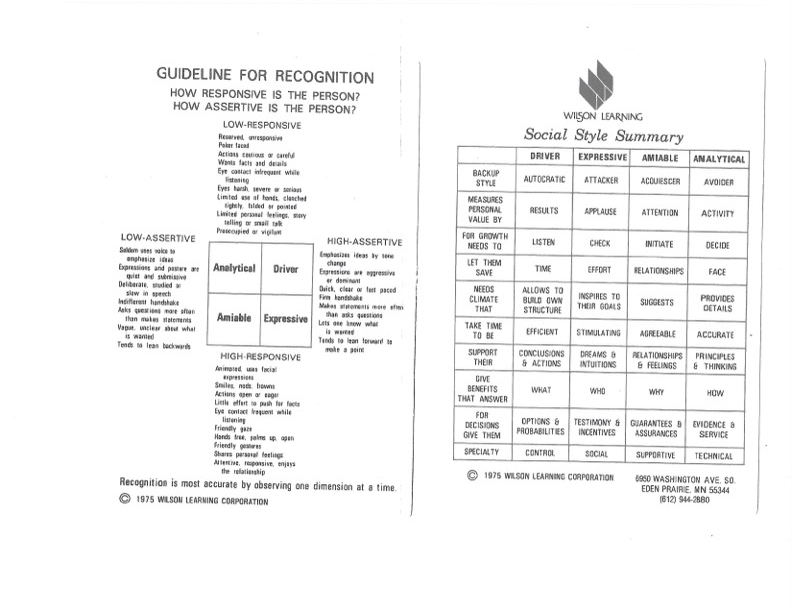
Use Image 3 to explain the social styles on the X and Y axis.
Have students get into groups with those who are similar to them and discuss what they like and what drives them crazy. Do this again with opposite styles.
The best results are to have everyone copy this Assessment Tool and give it to two or three people they work with. That’s the most accurate way to do the assessment
Image 1.
Social Style Assessment Tool
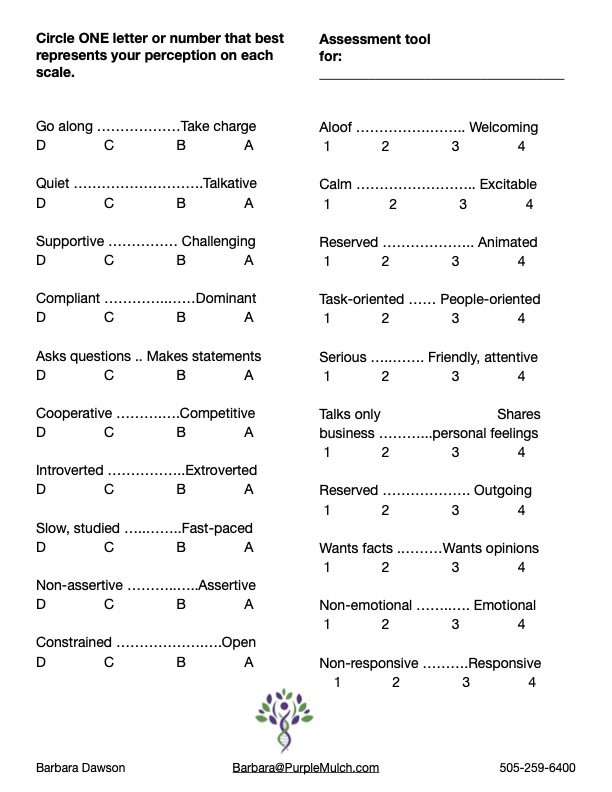
Image 2
Plot the results of the Social Style Analysis on this
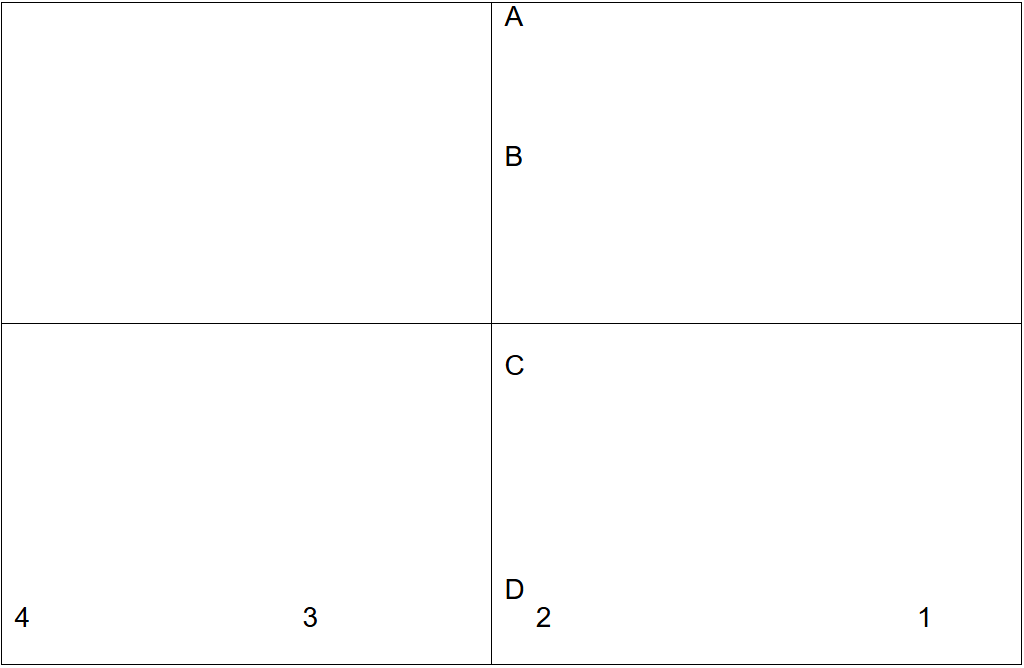
Image 3.
Social Styles Information Summary
Networking and interviews with Corporate Partners
- Presenting your icebreaker (90 seconds)
- Visume: Boring to Brilliant
- Introduction to Woodward Hall – Do it Yourself Studio
The Calling Project Overview
Each semester we determine the focus of the calling project. Most semesters we have one and some semesters we have two CPs. The Sales Center negotiates a flat fee which covers costs of the program and a scholarship incentive that is awarded to the students for successfully generating a “lead” for the CP.
Before each semester starts, the focus of the calling project is established. Most semesters we have one CP and some semesters we have two. The Sales Center negotiates a flat fee which covers costs of the program and a scholarship incentive that is awarded to the students for successfully generating a “lead” for the CP.
To secure these CPs, the Director of the Sales Center sends out a Request for Proposal and conducts interviews/organizational meetings with the decision maker of the CPs that send in the completed RFP. The student calling project may include:
- generating the lead from scratch
- calling from a CPs list of prospects
- calling from a CPs list of customers
Several class periods are used to acquaint the students with the CPs business, their value proposition – what they are offering the leads if they agree to take the next step, Students make calls during class time, usually for a total of 5-6 weeks.
The Room: must be secured before class is scheduled (UNM Responsible – Reach out to Kate Kennedy: 505-730-0982 so secure at least 2 rooms for role-playing and 3 for calling. May also need to talk to Sharae Scott who may be the one that sets up the semester’s room. (Kate has moved to another position.)
- Beginning semester: Room set up with chairs, minimal tables, in a circle or horseshoe format. It is important that the students can see each other and easily move around and connect with each other.
- For the calling project: 3 rooms are used with lots of space so the students can set up their laptop, headphones, notes and make calls without disturbing others who are calling. All students and the instructor have access to the internet.
- Computer for instructor
- Internet access.
- PowerPoint slides uploaded (Videos if used, embedded with CC) for each class period.
- Projector and screen available for viewing by all participants.
- Accessibility in the class: The host must initiate Closed Captioning (CC) on PowerPoint. This will allow it to be available for all participants on a screen (speaking/videos/audience participation). (Check to see how we can do this without putting a mic on everyone in this small classroom?) Do we have to have a mic to pick up the audio voice so it can be captioned. And must make sure the CC for host on PowerPoint, Google Meets or Zoom is set up in advance – one time.
- PowerPoint slides can be used to add visual clarity:
- Advanced Sales – Day 12- Project Calls .pptx — a sample flow map of making phone calls. Students are encouraged to write their own process out – as a mind map, linear process or what works for them to own the process.
- Advanced Sales – Day 15- Project Calls .pptx — a sample of a simple graphic – Ask – Listen – Repeat to remind the students that listening, re-creating, and connecting with the buyer’s emotional why is critical before presenting a solution.
- PowerPoint slides can be used to add visual clarity:
On-Campus Sales Competition
In sales features don’t sell; what sells is the benefit of having that feature that the buyer is looking for. It is important that the students find the buyer’s emotional why. For example, if the buyer is looking to buy a car the salesperson would need to engage the buyer, so the buyer shares what the car is for. Is it to take kids to school, look cool when driving down Central, be efficient in fuel usage, be dependable, carry a dog kennel, do off roading for camping, etc.? The students learn to not stop there and to continue to “dig” to find out what that will do for the buyer? It might be peace of mind, travel off road to commune with nature, take the family on a long-awaited vacation, have security knowing their spouse can make it home safely every evening, etc.
Examining the competition through Blooms Taxonomy. The first objective, once the student meets the buyer during the role-play, is to introduce themself, get the prospects name, and build rapport with them. This phase can be a combination of Remembering, Understanding and using the skills the students can Apply by using the person’s name, clarifying what the decision maker is looking for.
The second objective will be to engage the buyer in a conversation so the buyer can illustrate, summarize, and predict aspects of their purchases they would like to have more effective and efficient. This could be categorized into the Apply schema of Blooms Taxonomy. The students know this objective as doing a “discovery.” During all objectives, and especially discovery, the student will be Applying Information Processing Theory (Ormrod, p. 162). They will need to engage all their senses as they ask open-ended questions, listen to the words and also the intonation that may be a cue to the buyer’s emotional why. As the student applies what they have learned about the sales process, specifically engaging in discovery conversations, they will do the following:
- ask open-ended and open-lid questions so the buyer will talk openly. The students will be encouraged to take written notes and use chunking because of the cognitive load. They know the key advantages of what they will be selling in the role-play, so as they ask questions and get the answers, they can organize them in working memory (Ormrod, 2020,, p. 176) according to how the answers fit the product or service they are selling.
- clarify their understanding of what the buyer has said. Paraphrase the buyer’s words and add the emotion that the buyer has expressed.
- contrast what has worked or not for the buyer. Perhaps they have used a similar product or service in the past. Differentiate the experiences.
- help the buyer hypothesize what would happen if they could minimize the things that have not worked in the past and increase the things that would make their life their easier
- without getting into a presentation (just yet) checking or testing that what the buyer is looking for is what they are selling can solve
The third objective for the student is to apply what they have discovered from the buyer and present how the product or service they are selling can help the buyer solve the needs that were discovered. As they are constructing their presentation on the spot, they will use theories of Cognitive Play as they fill in the full picture and describe how their product or service can work in the buyer’s favor. Through the presentation, the students need to keep the dialogue conversational; monitoring and checking-in to see if the buyer is engaged. Again, Applying the techniques that they have learned through modeling, role-playing, and other simulated experiences.
The fourth objective is that the student will set the next appointment. In the competition setting this may be with a higher authority, someone who has ultimate authority for the purchase.
It is critical that the students practice and effectively confirm BANT: Budget, Authority, Need, and Timeline. Once the students have this, it is called discovery, then they can present the value proposition to the buyer efficiently and effectively.
Resources
Visume:
Do-it-yourself studio at Woodward Hall – contact is:
Manuel Machucam IT Support Tech 2, IT Academic Technologies: mmachuca@unm.edu
Resume:
Mercedes Dominique Metzgar
Career Development Facilitator
Anderson School of Management
metzgarm@unm.edu | mgt.unm.edu
Pronouns: She/They
Remote Tuesdays & Fridays

Off-Site Competitions:
Students in MGMT 484 can also compete in out-of-state sales competitions between various universities. The University pays the way for top sales talented students’ entrance, travel, room, board, and a coach to support them.