
MGMT 484 Course: Advanced Sales – Design Process
Independent Study Proposal – OILS 595
University of New Mexico
Albuquerque, NM
By Barbara F. Dawson, BS
Summer 2025
Special thanks and appreciation to:
Dr. Dionne Clabaugh for her support in editing and formatting this document
Dr. Law for his guidance and support throughout this project
Introduction
I have had the pleasure; heartfelt privilege and I treasure the work I’ve been asked to do of teaching students who are pursuing a career in professional sales. UNM’s Advanced Sales Course (MGMT 484) is a unique course. In MGMT 484 Advanced Sales, I approach sales mastery as more than skills – it’s a construct, a deeper understanding of human behavior that can’t be directly observed. With only 20 students supported by an instructor, coach, and TA, we can approach this challenging construct with care and curiosity. I bring heart to navigating what can be difficult to teach and even difficult to grade, focusing on hands-on, real-life experiences where Far Transfer becomes the meaningful goal of each module.
This course guide describes the structure, teaching strategies, and learning objectives of MGMT 484, Advanced Sales, offered at the UNM Sales Center, so that all course sections are taught consistently over time and across faculty. This guide describes the theory, structure, and intentions of the course. As the program expands, this document suggests a replicable course structure and format that meets with department expectations and outcomes for students, stakeholders at Anderson, and corporate partners. students, stakeholders at Anderson, and corporate partners. Additionally, as new courses are developed to address material not covered in MGMT 484, it is my hope that theory and practices are aligned with this course to not only provide consistent learning experiences for our students, but also relevant assessment data for program evaluation.
This guide is organized using the ADDIE model for instructional design. Within that organization it has three sections: course overview; course structure, theory, and practice; and a Facilitator’s Guide that describes the teaching and assessment strategies. The appendices provide a learner and content analysis, learning goals and objectives, sample application of Bloom’ Taxonomy, suggested course syllabus, assignment rubrics, bibliography, and selected faculty resources.
Course Overview
MGMT484 prepares students for successful careers in professional sales by giving them a hands-on experiential learning experience which is underpinned by a philosophy of practice, repetition, and constructive feedback. This course is designed to ensure a consistent and high-quality learning experience so that students will be successful in learning and applying course content to their development in sales. Currently, MGMT 484 remains the only advanced sales course offered each semester. At this time, a lead instructor, a sales coach, and a teaching assistant (TA) are in the classroom each day.
Course Structure, Theory, and Practice
The course, MGMT 484, is organized into four distinct and interconnected modules. Each module uses authentic communication as the foundational skill. These modules are Authentic Communication, Networking and Interviews, a Calling Project, and On-Campus Competition.
Data shows that leaders excel in a job or business when they have superior emotional intelligence, which is how well they effectively engage and communicate with others. This is a powerful transferable skill. “Empathy – and emotional intelligence. Actively listen to the needs and ideas of colleagues. Promotes teamwork and creates a company culture that is open to growth and new ideas” (Snead, 2025). “A Yale University study found that those teams that have strong emotional intelligence showed 23% better decision-making, 58% fewer conflicts, and 30% faster problem-solving than teams with stronger technical skills but lower EQ” (Ivy Exec., 2023). Given those statistics, the importance of effective and authentic communication is the core skill and practice that intersect all modules in this course.
The learning theories that are practiced throughout the instruction of the course are constructivism as the grand learning theory. The other learning theories practiced are cognitive apprenticeship, experiential learning, and peer/collaborative learning. These are detailed after the Evaluation portion of the paper.
The ADDIE Model Overview
This instructional design will be developed and delivered based on the ADDIE Model. This model was selected because it is a well-respected and a tried-and-true model for instructional design (ID). “ID is rarely a simple process. In practice, designers often draw upon personal experience and the wide variety of models, strategies, and theories to customize each instance of instructional design,” (Dousay, p 18).
Here is a brief description of ADDIE as modeled from the Digital Learning Institute (2023). Supporting information and tables are provided in the Appendixes.
Analysis: What are the learner’s needs?
Design: How will the course be delivered?
Develop: Instructional materials, activities, and assessments based on the detailed design plan.
Implement: How will content be delivered to the learners. Learning and Instructional Theories described.
Evaluate. Check the students’ application, practice, and transfer of the modules’ focus.
Analysis
Student Analysis
The primary audience is students who are pursuing a career in sales and are in the Advanced Sales Course (MGMT 484) at the University of New Mexico (UNM). All have completed the prerequisite Professional Sales (MGMT 384) and have had experience selling through an app to a bot. Some students may have limited sales experience in retail, their own business, a side gig, or with a family business.
The purpose of this instructional design to create a course to give the students effective and efficient learning experiences is to improve their communication skills, gain experience in sales, take a conversation to the next appropriate step, and increase their preparedness to secure a position in sales before graduation. If the problem is solved, students will be able to confidently engage in conversations that can lead to income generating sales. Everything we do in the course will be connected to or scaffolded for successful experiential learning and transfer to life beyond the university. We want students to leave this class with functional knowledge to succeed beyond the acquisition of a grade in class.
The learner characteristics and considerations of all students who have taken MGMT 484 in the past two years is detailed in Appendix A. Future students will be similar and perhaps at a higher level of commitment because they successfully interviewed and were accepted into MGMT 484. Overall, learners taking this course represent diverse ethnic backgrounds and are primarily UNM juniors and seniors. They have completed prerequisite sales coursework. These students possess basic job application skills, maintain positive attitudes toward Sales Center opportunities, and demonstrate both intrinsic and extrinsic motivation. They generally hold favorable perceptions of themselves and their peers.
Context Analysis
MGMT 484 is structured in four main modules with Authentic Communication being the foundational skill of all modules see Figure 1. The following modules Networking and Interviewing with Corporate Partners, The Calling Project, and On-Site Sales competitions are built on a strong communication foundation. These are listed below and expanded upon in Appendix B. Everything we do in the course will be connected to or scaffolded for successful experiential learning and transfer to life beyond the university. We want students to leave this class with functional knowledge to succeed beyond the acquisition of a grade in class.
Figure 1
Authentic Communication at the Core of MGMT 484
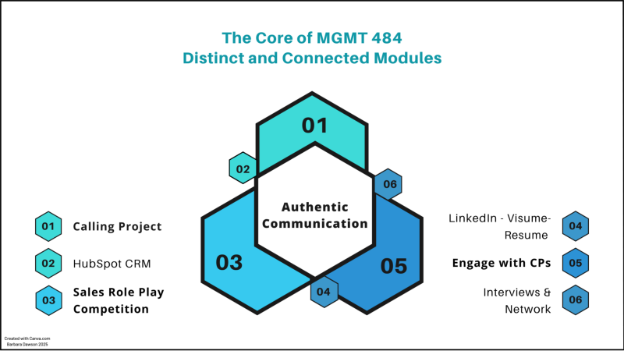
First, emphasis is placed on authentic and effective communication. This is used throughout the semester and beyond the classroom; far transfer is the goal.
Second, the students are given opportunities to network and interview for jobs with the CPs of the Sales Center. They create effective resumes, cover letters and a visume (a visual resume). At least one networking event is offered towards their grades. In addition, CPs are invited to campus to interview students who have created a visume and want to share it with the CPs. Jobs and internships are often given if the interviews go well.
Third, each semester a “calling project” is negotiated with at least one Corporate Partner (CP). You could equate this to a mini fieldwork experience. This CP, the instructor and the Director agree upon an outcome and students are tasked with five to six weeks generating qualified leads for the CP by cold calling.
Fourth, all students in MGMT 484 compete in an on-campus sales competition. This competition is a live, two-round role-play sales competition through in-class teaching and coaching.
Design
This course, Professional Sales (MGMT 484), focuses on the acquisition and application of professional sales and business development skills through experiential learning. It is structured using four main modules listed below. The detailed learning goals and learning objectives are in Appendix C.
This and all modules will base learning in Cognitive Apprenticeship which is “a flow of learning which includes modeling, coaching, scaffolding, articulation, reflection, increasing complexity and diversity of tasks, and exploration” (Ormrod, p. 356). We will also apply Experiential Learning Theory (Kolb & Kolb, 2017). Adults learn best when they are engaged in learning. For this course’s purposes, we want to engage the learners in the process so they can participate fully, ensuring that learners can cultivate strong life-long learning processes that can take them far in their careers.
Authentic and Effective Communication Design
Authentic and effective communication is the focus of the first module. These skills are used throughout the semester and beyond the classroom; far transfer is the goal, meaning that beyond the classroom in work, at home, and in community service, they will continue to use these skills. The components include listening: active listening, effective listening, listening for understanding; asking questions, open-ended, open-lid and questions to confirm understanding; and ensuring others know they have been heard by effectively re-creating, restating what was shared including the emotions, and moving the conversation forward. In addition, the room is set up in a circle which promotes visual, auditory, and face-to-face engagement. Our goal, creating a safe space where respect, inclusion, and honoring our differences mirrors the ideal environment for counselor selling as service. Sitting “in the circle “is a metaphor for all these things.
Upon completion of this module, the learner will be heard applying open-ended questions, active listening, and re-creating in conversations with colleagues and during in-class role-plays.
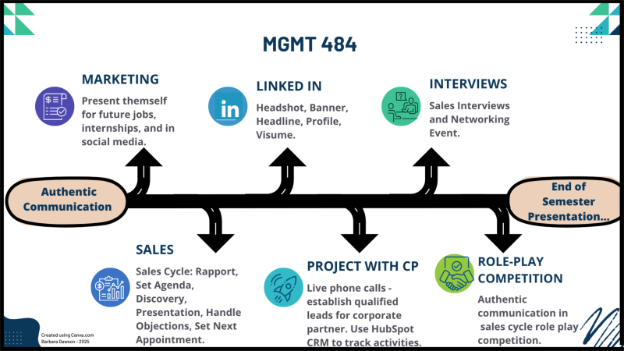
The image of a graphic organizer in Figure 2, illustrates how all modules and learning have authentic communication at their foundation.
Figure 2
Graphic Organizer – Authentic Communication, a Transferrable Skill
Each lesson starts by posing a question to the group, for example, “What is communication?” Everyone is given time to respond. At times learners will be paired up, put in small groups or a question will be posed to the entire room. Discussion is facilitated by the instructor and/or lead coach. Everyone has a degree of understanding about the topic and the value it has in their lives and in sales. When a question is posed, it inspires a need to know in the learner. Students engage in the knowledge they already have. Some of it may be foundational, and some may be perceptual. The structure to the learning modules is:
- Ask a question
- Let the students work with the information to create their own solution
- The students present their solution to the class
- Then the instructor adds information on the topic
- Reflection is encouraged to lock in the new information
Recently one of my mentor’s, Patricia Fripp, said in a post, “Don’t miss this chance to bridge the gap between knowledge and mastery. Recently, someone asked my brother, legendary guitarist Robert Fripp, about the challenge of applying what we learn from books and articles. His response was profound, “We can find 70% of necessary information through reading – books, articles, and online. The remaining 30% we can only find through someone who knows, someone who lives their knowing, being in their presence, breathing their air. Unless we know that 30%, we have little chance of understanding the 70%” (Fripp, 2025). The objective of each class is to help the students, through experiential learning, become one who lives their knowing of authentic communication in class, at home, in the workspace, and the community.
Network and Interviews with Corporate Partners Design
In the second module, students are given opportunities to engage with all the CPs of the Sales Center. Students develop job search materials including polished resumes, targeted cover letters, and visume (visual resumes) that showcase their skills and experience. This module integrates networking opportunities directly into the curriculum, with at least one networking event contributing to students’ grades to emphasize the importance of professional relationship building in the community.
Upon completion of this module, the learner will be able to successfully apply effective communication skills when engaging in a job/internship interview and when networking at the Sales Center’s three hour-meeting
To bridge the gap between academic preparation and career opportunities, corporate partners (CPs) are invited to campus for on-site interviews. These CPs are given access to and can review all student visumes in advance, selecting ten to 15 candidates from MGMT 484 and MGMT 384 for interviews based on their initial impressions. This process frequently results in job offers and internship placements for students who perform well in interviews, creating a direct pathway from classroom to career.
Calling Project Design
The third project, the Calling Project, is designed to give students an experience of one of the first jobs many salespeople take and that is cold calling. In sales there is always the need to “keep the pipeline full.” This module reflects that real-world experience when the students call to generate leads or introduce a new project to existing customers for a corporate partner.
Upon completion of this five-to-six-week module, the learner will be able to successfully take a decision maker through the sales process from rapport, through presenting the CPs value proposition, and setting the next appointment at least 25% of the time.
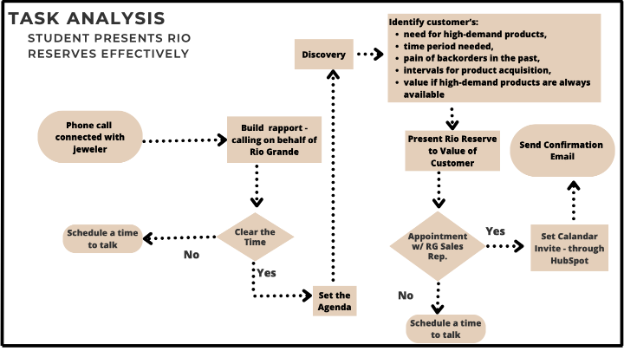
Viewing this project as a Community of Practice, Ormrod’s (2020) framework, this group of sales students “share common interest and goals and regularly interact and coordinate their efforts in pursuit of those intreats and goals,” (e.g., R. Hall & Jurow, 2015; Lave, 1991; R.K. Sawyr & Greeno, 2009; Wenger, 1998), (p. 354). The community members “learn the acceptable ways of doing things primarily by actively participating in the community” (Ormrod, p. 354). In the case of MGMT 484 the students are actively participating in lead generation. They are not expected to go through the entire sales cycle. They are given the novice activity, do the first call, find a qualified lead, and get them to schedule an appointment with a CP’s salesperson. They are given minimal responsibility, and the expectation is that they will “acquire greater competence and slowly take on more central roles, in particular activities until, eventually, they’re full-fledged participants (Lave & Wenger, 1991; Rogoff et al., 2007) (Ormrod, p. 355). In other words, if they can get comfortable doing the uncomfortable, then a job in sales will be achievable. That is the main goal of this module. Figure 3 represents a flow chart of a student talking with a past lead in a previous semester.
Figure 3
Flow Chart of a Student Presenting, on the Phone, the Corporate Partner’s Value Proposition Effectively.
Before the calling project begins, several class periods are used to acquaint the students with the CPs business, their value proposition, resources to take the next step, and possible talk tracks. A field trip to the CPs business location may also be included.
The students are not new to sales; they come into the course with basic sales terminology and an understanding of the sales cycle schema. They have practiced role-playing in the Professional Sales course (MGMT 384) with a buyer that was an AI bot. Success in that environment was often tied to memorizing questions that prompted predictable responses from the bot. It is our intention to provide “Occasional repetition of learned information over a longer period of time, which enhances the storage and retention,” (Ormrod, p. 237). However, real-life sales interactions are far more dynamic. Students must develop deeper understanding, apply their communication and sales knowledge, and analyze the buyers’ needs through carefully asking questions and listening. At the end of each calling session, time is allocated for the students to share wins, frustrations, take-aways, and spend time in reflection. Experiencing this process, the student will improve their cognitive knowledge to finally evaluate and then create their own strategies that work with their authentic communication. Appendix D evaluates the calling project using Bloom’s Taxonomy.
As the students make their way through the phone calls, they will be asked to reflect on their learning. To do the self-analysis of tweaking their process so it fits their authentic way of communicating. Even though there are certain things that must be filled in in a specific way (the HubSpot CRM notes, the calendar-invite, the Lead Sheet) the bulk of the process is on them learning from their experience, learning from listening to their peers, the coaching and scaffolding provided by the lead coach, instructor, and the TA. They are using cognitive, socio-cognitive, and meta cognitive aspects of learning.
The students’ course-work goals are twofold. First when qualified leads are generated, students are incentivized with a payout from the CP in scholarships’ dollars awarded to their bursar’s account. Secondly, the students’ grades in class are weighted based on their work on the project. In adult education, the emphasis is on intrinsic motivation and well-being. Generally, grades are viewed as less important than the practical benefits or mastery of skills. A portion of the students’ grades are given based on their performance in the calling project. They are given goals to reach (number of calls per week, number of emails sent, and how well they fill in HubSpot). In addition, the CP awards scholarships to the students’ Bursars account based on the appointment set with a qualified lead and if the lead kept the appointment. This is more like real-life sales.
On-Campus Sales Competition Design
The fourth module is an on-campus sales competition. This competition is a live, two-round role-play sales competition through in-class teaching and coaching. The live role-play for fall 2025 and spring 2026 will be with the Corporate Partner Rich Ford. The competitions will be held at the Rich Ford dealership. The CP will give the top performing students scholarships in their UNM bursar’s account.
Upon completion of this module, the learner will be able to apply communication and sales skills where they will help a buyer solve their concern and set the follow-up appointment building a transferrable skill to a future job.
The on-campus sales competition has two rounds. All the students will participate in round one. With 20 students in the class, five will be assigned to each room where they will each meet a buyer. The top student from each room will move on to Round Two.
Class time is spent before the competition and during class, the students will be given information about the product or service they will sell in the competition. They will be instructed to take the features and create questions that could be asked of a buyer to see how the features could be a benefit.
Students are also evaluated on how well they take the buyer through all the steps of the sales cycle and their communication skills. Do they have a lot of filler words (um, ah, you-know). Do they engage effectively with exceptional communication skills and emotional intelligence?
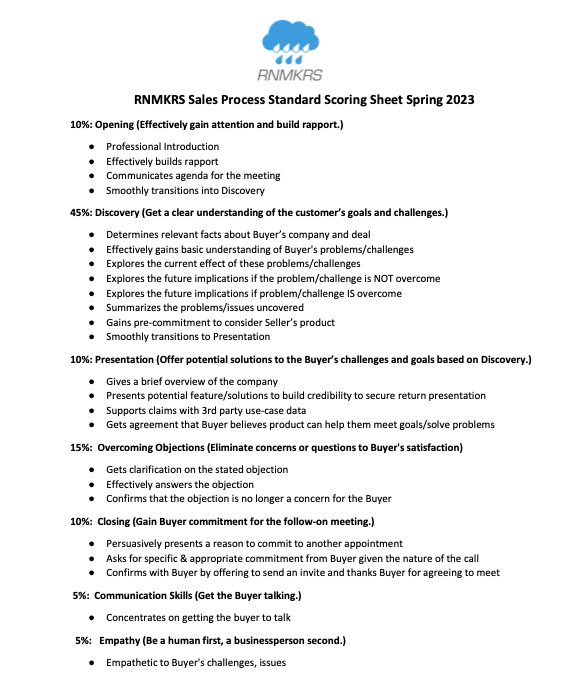
Judges are given a rubric, which the students have access to, to score against the students during the competition. Once the Round One competition is completed and the scores are all tallied, the top student from each room will move on to Round Two. This competition is conducted over several days.
The students will be graded based on where they placed in their room, and the final five will also be graded based on where they placed in Round Two. In addition to a grade in class, the CP who sponsors this activity presents scholarships to the students which go into their Bursars account.
Development
In this development section, each module will be examined based on the design of each module. Instructional materials, general activities, and theory will be the focus. Many more details of each day’s activities can be found in the syllabus in Appendix F and in the Facilitator’s Guide at the end of the paper.
Authentic Communication Development
The topics covered are
- Active and passive listening
- Open-ended and open-lid questions
- Asking follow-up questions based on the listening
- Digging deep – the true emotional why is usually not the first response
- Engaging with Active Listening by Re-creating, with the emotion, of what was shared
- Moving the conversation forward
- Social Style versatility
Networking and Interviews with Corporate Partners Development
Students enter MGMT 484 with an existing LinkedIn profile, visume (a video resume) and resume that they created in the prerequisite course, MGMT 384. The final video is done on campus at the do-it-yourself studio at Woodward Hall, which the students can reserve. We will encourage them to go in groups and get their visume professionally recorded. During this module, the focus of their 90 second visume is on moving their visume from boring to brilliant, the importance of a good “hook,” and finding an experience in their past, a mentor, a coach, someone who has significantly influenced their life choices. We help them craft their visume from there. They are encouraged to look at past successes and wins and to let their potential employers get to know them, their competencies, discernment, and mindfulness. Students practice in front of the class and with each other giving and receiving positive feedback and suggestions for improvement. As they practice in front of each other, the focus goes beyond the words, and the students are encouraged to add vocal inflection, intonation, gestures, body language, and eye contact.
Students are encouraged to up-grade their resumes to make them more appealing to the CP they would like to work for or do an internship with. Adding an “about me” section to their resume encourages them to personalize and highlight their skills that would fit with their ideal employer or internship opportunity. The current AI and SEO focus of online resumes is discussed.
In preparation for the networking and job interview day, class time is spent practicing rapport building, authentic communication, interview skills, how to handle tough questions like “When is a time that things did not go well on a job? How did you handle it?” so the students can effectively handle the unexpected. We also review the systems and acronyms they have seen, though perhaps not practiced, that are included in this document: Performance-Content Matrix Interviewing and Networking-INTERVIEWS.
The Calling Project Development
Developing the communications skill set in the students so they are comfortable and know how to establish rapport quickly when “cold calling” customers for the Corporate Partner is a key objective. The theoretical foundations of adult learning will be the lens through which training and education will flow. Experiential learning, realistic simulations, peer collaboration, immediate application, differentiated instruction, quick feed-back and finally reflection on what worked, and what didn’t will be the focus of the instruction to deepen their learning and build confidence.
Cold calling presents significant anxiety for many students, requiring structured scaffolding to build their confidence and competence. Our approach focuses on gradually acclimating students to this challenging communication task through multiple supportive strategies. These include role-playing exercises with instructors and peers to practice interactions in a safe environment, comprehensive review of CP’s sales materials to strengthen students’ product knowledge and messaging, peer mentoring where struggling students observe confident cold callers, one-on-one coaching sessions where successful students share their thought processes and strategies, and instruction in mindfulness techniques such as centering and grounding exercises to manage pre-call anxiety. This multi-faceted approach addresses both the technical and emotional barriers that prevent students from succeeding in cold call scenarios.
The integration of new information about CP operations requires students to either assimilate this knowledge into existing cognitive frameworks or accommodate entirely new conceptual structures. This learning process is particularly challenging given the multi-platform nature of the information students must navigate during live sales calls. Students must simultaneously access and synthesize data from HubSpot CRM, and course materials housed on Canvas.unm.edu while maintaining focus during real-time client interactions.
Students have developed various adaptive strategies to manage this cognitive load. Some employ dual-device approaches, bringing both laptops and notepads to class for simultaneous viewing of multiple information sources. Others utilize split-screen configurations to access both platforms concurrently on a single device. Regardless of their chosen method, students face a substantial learning curve in mastering the CP’s business model, product or service offerings, and the real-time interpretation of complex information during active sales conversations.
This challenge extends to instructional design, as educators must ensure seamless information accessibility so students can retrieve necessary data efficiently during calls. To systematically address these learning objectives and organize the target behaviors and competencies we track and develop according to Bloom’s Taxonomy framework (Ormrod, p. 236), explicitly connecting the cognitive processes underlying effective sales performance to established learning theory. Appendix D charts this out in Bloom’s Taxonomy.
Actionable strategies that support student motivation, especially as it relates to relevance and confidence in the ARCS Model (Keller, 1987), are taught. Evidence-based approaches grounded in adult learning and resilience-building are used. Some coping strategies are taught, for example, a no is not a reflection of the salesperson’s personal worth. Rather it may be an expression of the buyer’s lack of understanding or kNOing enough. A “no” may be that they are NOt ready at this time; it may be a NOt yet. Mindset is discussed where each sales interaction is a chance to improve their skills – coaching helps them work through this. Encouraging reflection after each call – what went well, what could be improved – encourages students to keep a journal of each interaction. Individual practical methods like setting an intention, meditation, and tactical breathing to work through the day-to-day process of cold calling are encouraged. Time-management strategies are discussed and modeled because students are only calling during class time. This is modeling the consistent patterns and work schedules which are critical for success in sales. Focusing on process over outcomes role-plays are used to simulate the calling process including rejection scenarios so students can practice objection-handling in a safe environment with debriefs after each session to reinforce learning and self-reflection. In addition, peer feedback helps them all create a strong bond with each other. As in military boot camp, doing something hard together makes life-long relationships.
On-Campus Sales Competition Development
For the on-campus sales competition, one of our corporate partners helps create a sales scenario. For the next four semesters, we will be partnering with Rich Ford. The product training and some of their successful methodologies for selling new cars and trucks will be provided at their location in Albuquerque. Class time will be spent focusing on the following:
- What are cars used for?
- Why might someone be looking for a new vehicle?
- What are the features that a vehicle has?
- What are the various answers a salesperson might get to questions about BANT (Budget, Authority, Need, and Timing)?
The different scenarios are discussed as a class and then students are paired up in dyads to practice. One student does the role-play being the buyer and the other the salesperson on the showroom floor. They practice using authentic communication to establish rapport and then move into discovery. At this point, we are not presenting, just considering all the benefits someone would be looking for in an automobile purchase. The presentation training will happen when the students go to the sales room floor. Times are allocated when the Rich Ford coaches will be available to teach the students how to present the car or truck. Students are responsible for getting to those coaching sessions by themself or with a small group outside class time.
The students will practice while considering the different social styles that people express. Sometimes people are open and easily share, sometimes they are low-responsive and hard to engage with. Students learn by doing and through coaching. Students learn ways to move forward, not take things personally, and learn from experiences and each other.
Implementation
According to the UNM course catalog the course objectives indicate that students will:
- Master the steps of the sales process
- Participate in a class role-play competition
- Participate in professional networking opportunities
- Build experience with prospecting, lead generation, lead qualification and quota attainment
- Participate in engagement opportunities with the corporate partners of the UNM Center for Sales & Business Development
The specific student learning outcomes are to
- Develop a value proposition
- Identify prospects
- Approach the prospect
- Identify the needs of the prospect
- Present the value proposition
- Negotiate the prospect’s concerns
- Close the sale (depending on the CP – this may be set the next appointment)
A Facilitator’s Guide is provided at the end of this paper which details the way the learning and instructional theories are blended for the course. The details for each module are also provided in Appendix G.
Given the experiential nature of this course, the students realize early on that this course is different. There is not one textbook that data will be pulled from for exams and homework. Most of the work is done in class and it does not mean that they don’t have to prepare for the daily practice. The following Table 1 shows some of the knowledge gaps and scaffolding that the instructor will work around.
Table 1
Processes requiring scaffolding are provided to support a learner to effectively meet the learning goals.
| Process | Learners may need support to: |
|---|---|
| Engage in Conversation | Start a conversation with a new person. They may need some practice, one-liners to use to start a conversation. |
| Demonstrate that they are listening | Practice asking open-ended questions and re-creating what someone has said during training activities. |
| Personal Growth and Development | Exercise self-efficacy and self-advocacy in order to develop the personal growth that comes with speaking in public, making a visume, looking for a job in sales, and other human encounters. |
Evaluation
The evaluation theory that is used and practiced for this course is primarily formative. Formative means informing the students of what they are doing well multiple times along the way and providing strategy-focused feedback, “You are doing XYZ very well, and here is what I’d like you try and improve.” The data and research of using formative feedback is striking, in that it increases motivation. Coaching and peer evaluations are encouraged during each class period. Students are actively participating in this experiential learning experience every day, and the room is set up as a safe space for feedback, encouragement, and suggested areas for improvement.
There are a few summative evaluations that have a deadline and are necessary for the students to get a grade.
- Visume: has a deadline so CPs can receive them and determine interviews
- Leader Board: is formative during the Calling Project it shows students where they stand through the calling sessions. It is also summative at the end of the project because students see how many qualified leads they have secured.
- On-Campus Sales Competition: students are judged during the role-play and rank determines their grade and scholarships from the CP.
- End of semester presentation: This summative evaluation is the last day of class when the students present to the CP for the Calling Project.
Continuous improvement assessment and feedback are used to refine and improve the learning experience both from a behaviorist and cognitive perspective. Each day when added information is presented, students are asked to reflect on their own learning and their comments are recorded and transcribed. These student artifacts are used to evaluate the course as it progresses.
Bloom’s Taxonomy provides an excellent cognitive framework for this course and is used as the basis for assessing each student’s demonstration of learning objectives related to cognitive learning outcomes. Higher order thinking skills—remember, understand, apply, analyze, evaluate, and create—will be emphasized to systematically address the learning objectives of the Calling Project. Appendix D examines how Bloom’s Taxonomy is effectively used throughout that module, organizing the target behaviors and competencies we track and develop according to Bloom’s Taxonomy framework (Ormrod, p. 236). This approach explicitly connects the cognitive processes underlying effective sales performance to established learning theory. In addition, cognitivism, social cognitive, metacognitive, and constructivist learning theories will be applied.
Evaluation of Students – Module Rubrics
In addition to the module rubrics that are illustrated in Appendix E, we want to evaluate the student’s level of confidence and perceived competence before and after each module is introduced. Many are often overly confident in what they think they know about a subject, and there are also times when people do not think they know enough. As instructors, we are trying to gauge the starting point of the subject.
To help determine the learner’s confidence and competence for a module, we begin a module with a self-evaluation. In some cases, because of inherent bias, we suggest the learner also give a copy of the evaluation to someone who knows them well for their assessment. This is especially valuable with Emotional Intelligence and Social Styles. Below are the assessments that are used:
- Communication and emotional intelligence
- Social Styles: Social Styles Assessment Tool
- Emotional Intelligence: 1-Quiz-Yourself-Do-You-Lead-with-EI-2
- Sales Cycle & Role play –
- Survey – Confidence in Sales Cycle: Survey – confidence in sales process
- Networking/LI/Interviewing for job
- Tough Questions based on: Performance-Content Matrix Interviewing and Networking-INTERVIEWS
Learning Theories
This course is grounded in several learning theories. The Grand Learning Theory is Constructivism. I have taught adults in many settings. I am often inspired to try something new in the classroom and I usually go with it. Through my course of studies in OILS I have studied many learning theories. Knowing that there may be other learning theories which would support the work in MGMT 484, the following, my humble learning theories, are the core that I use and embrace now. My Humble Learning theories include Cognitive Apprenticeship, Experiential Learning, and Peer Collaborative Learning.They are described below.
Constructivism
The grand learning theory in this design for UNM’s MGMT 484 course is constructivism. Ertmer and Newby (2018) define constructivism by stating, “… is a function of how the individual creates meaning from his or her own experiences” (p. 141). In this instructional design, the goal is to ensure that the students can relate the class to real-world experience as a professional salesperson with a learner-centered education. That includes problem solving and creating new meaning through their own personal construction, relating with each other, and not through information that is transmitted from an instructor, book, or other learning tool. This aligns with the work of theorists like Piaget (cognitive constructivism) and Vygotsky (social constructivism), both of whom emphasized the active role learners play in building understanding (Ryan and Deci, 2000). Each time a new topic is introduced, the intention is that the students scaffold their new learning onto existing mental frameworks. For example, most learners can recall what good and bad communication feels like, and throughout the modules, their existing understanding is built upon. That is how constructivism is being used in this design.
My Humble Learning Theory
The humble learning theories guiding this design are cognitive apprenticeship, experiential learning, and peer collaborative learning. All of them work together to give the students ways to build on what they already know and scaffold greater competencies in communication and sales. Here’s an explanation of each.
Cognitive Apprenticeship
The course employs cognitive apprenticeship to make thinking visible (Collins et al., 1991). This approach mirrors how learning occurs naturally through everyday social interactions (Denner & Bruner, p. 436).
One of the competition students in Spring 25, demonstrated this process beautifully. Committed to excelling in the competition, she came over to our practice session. Before jumping into more role-play practice, I asked her to reflect on what she already knew. When she articulated her understanding, I implemented scaffolding by having her represent the main ideas of Gartner (the company she was representing) on one side of her paper. On the right side, she mapped potential customer needs and pain points. Through coaching, she deepened her understanding of discovering the “emotional why” behind customer needs. This practice paid off—she finished in the quarter finals at the national competition!
During the Calling project, here are some examples of how cognitive apprenticeship model is effectively used:
- Modeling: Instructor demonstration followed by peer modeling. Once students are all making calls together, if one person is effectively setting appointments, the students who are within earshot can try some of the communication styles of the more accomplished students.
- Coaching: Instructors provide concrete guidance in several ways. 1) sitting beside the student while they are calling and coaching after the call 2) during a student to customer conversation, the coach offers real-time written suggestions. For example: so, what I heard you say …, what sounds most interesting to you? …, tell me more …, I’ll suggest that the next step would be …, etc. Peers can also offer feedback, what did they do best? What can be improved?”
- Articulation and Reflection: At the end of most classes, we ask students to express their “take-aways” from class. A Google Document is created using voice to text captured on the TA’s computer. The goal is for them to reflect on their learning. We review the takeaways and note confidence levels, how they are thinking, and any unresolved questions. We incorporate some of these student artifacts in our preparation for the next class.
- Exploration: “Forming and testing of one’s own hypotheses” (Denner & Bruner, p. 427). As part of the preparation and practice, students are encouraged to create a mind map or a talk track they can use when making phone calls. Using what they know and making it their own so they can explore what works for them.
Experiential Learning
In this course we will leverage the overlap between learning theories and instructional design. We want to keep the education theoretically and practically grounded for an effective student learning experience (Kolb, 2014). Assuring that during the in-class hands-on experience, students are given opportunities to try things out using collaborative problem-solving in a safe environment and then do peer-feedback and self-reflection. Role-play experiences are used to practice authentic communication, before putting them on calls, into interviews, networking experiences, or competitions. We will give them sample “talk tracks” before the Calling Project and they will be encouraged through mind maps, decision trees, or images to make the experience authentically their own (Kolb, 2014).
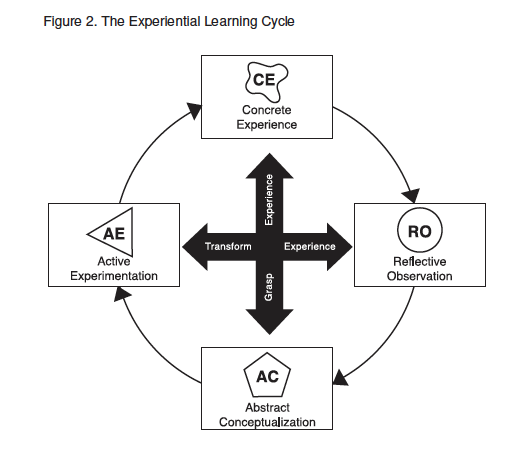
Assuring that during the in-class hands-on experience, students are given opportunities to try things out in a safe environment. We’ll start with role-play experiences before putting them on calls, into interviews, networking experiences, or competitions. We will give them sample “talk tracks” and they will be encouraged through mind maps, decision trees, or images to make the experience of calling authentically their own. For a learner to engage fully in the learning cycle, a space must be provided to engage in the four modes of the cycle—active experimentation, concrete experience, reflective observation, and abstract conceptualization (Figure 4). It needs to be a hospitable, welcoming space that is characterized by respect for all. The space should welcome genuine conversation among equals. It needs to be safe and supportive but also challenging. It must allow learners to be in charge of their own learning and allow time for repetitive practice that develops expertise. (Kolb, 2017, p. 33). This theory states that professional skills are usually updated through engagement in active learning by connecting prior experiences to new ones and sharing information with others through reflection and hands-on activities. Kolb (2014) who originated this theory states, “…people construct new knowledge and understanding from what they already know and believe based on their previous experience” (p. 297). In Advanced Sales, learners view sales from their experience. They engage with others in the class, reflect on their experiences, and generate new knowledge. The learner actively creates their learning process, and they are not a passive recipient of information (e.g., only direct instruction by PowerPoint).
Experiential learning encourages curiosity and active engagement from each learner with instructional content. This will also encourage self-efficacy and give them confidence that sales is perhaps not as hard as they thought, and they can understand how it impacts them as they pursue a career in sales. This can give them the confidence to talk to others and promote self-advocacy too. Figure 4 below is taken from Google in a search of Kolb’s work. It covers the processes in experiential learning.
Figure 4
Kolb’s Experiential Learning Cycle (Kolb & Kolb, 2017)
Peer/Collaborative Learning
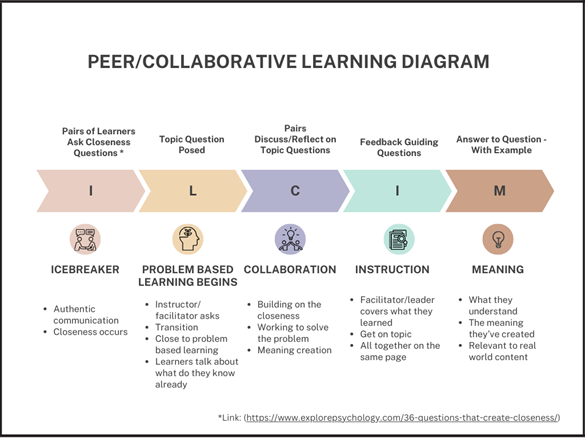
This theory describes success as being facilitated through learning via collaboration with peers. However, before diving into peer/collaborative learning, it is beneficial to start with an icebreaker because it helps build trust and rapport. Chlup and Collins state, “They [icebreakers] help group members get acquainted and begin conversations, relieving inhibitions or tension between people, allowing those involved to build trust with and feel more open to one another. Icebreakers encourage participation by all, helping a sense of connection and shared focus to develop” (p. 34). Bringing them into small groups they do not know and having them start with an icebreaker activity helps build trust and rapport before they work together on a common problem after the activity. This also helps the learners actively engage in conversations with one another from the start through the closeness questions to streamline the connection between learners via a sense of closeness. We can use the 36 Questions That Create Closeness. This tool can be used in the section of the course where we have students pair up and go for a 15 minute “walk about.” It is a way for them to practice authentic communication, and we then relate it to building rapport and discovery as part of the sales cycle. Figure 5 illustrates the steps that follow using an icebreaker as part of the peer and collaborative learning experience and how it progresses.
Jeffries and Ahn (2024) elaborate by discussing how peer/collaborative learning can be used effectively by encouraging teamwork, embracing diverse perspectives, facilitating communication, and to help learners gain a stronger understanding of the content being discussed. For example, the instructor will start a new topic with a question, such as “What are corporate partners looking for in a visume?” The learners will be asked to get into groups of 2 or 3 people who they don’t know well and discuss this question. In this way, they will collaborate with others through open discussions on the topic by problem solving collectively while creating their own meaning. This helps build a sense of community and inclusivity as they get more comfortable with each other.
Figure 5
Using an icebreaker as the start of peer/collaborative learning experience
Appendices
Appendix A. Relevant learner characteristics
Appendix B. Relevant context analysis for the four course modules MGMT 484
Appendix C. Learning goals & Learning objectives
Appendix D. Bloom’s Taxonomy Analysis of Objectives during the Calling Project
Appendix E. Evaluation Rubrics for Each Module
Appendix F. Syllabus, PowerPoint, and Support information
Appendix G. Instruction of implementation for all modules
Appendix A: Analysis of Relevant Learner Characteristics in MGMT 484
| Learner characteristic | Variability/range |
|---|---|
| General descriptors (age, gender, race & ethnicity, group size, etc.) | Students are of all ethnicities, races, gender, and primarily in their late teens to early 20s. For some students, they are the first to attend a university in their families. For others, they come from a long line of university graduates. Many of the students work while in school even though most are awarded the lottery scholarship that’s available in New Mexico. Some of the students may live on campus, at home with parents or their nuclear family, and some are married and may have children of their own. |
| Knowledge (general and domain-specific content knowledge) | Learners are typically junior or seniors at the University of New Mexico. All learners have taken the pre-requisite to this class called Professional Selling (MGMT 384). They have an interest in sales and marketing as a career. All learners were required to schedule an interview for admission into MGMT 484. The interview process was conducted by the Director, the lead coach, and two alumni of the UNM Sales Center. Once approved and accepted, they were required to register with “instructor approval” the first week of open registration. |
| Skills (ability to do things relevant to instructional goals, tasks, social skills, etc.) | All students bring their laptop to class and so have a high comfort level with technology. Most students are familiar with the dashboard called Canvas where all course content/materials and assignments are kept. Students have a general knowledge of the following from the prerequisite MGMT 384: The sales cycle A LinkedIn account A Resume A Visume Some have marketing experience with HubSpot which we use for customer relationship management |
| General Ability (this may be personal, developmental, experiential, etc.) | The students given a “yes” during the interviewing process showed an ability to engage in conversations effectively, demonstrate that they were a self-starter (this course requires students to figure some things out on their own – like in the real-world), and the appearance of working well with a team. They may have a varying degree of experience and comfort level with speaking in public, presentation, competition, and sales. |
| Attitudes/Goal sets (content, training model, organization, etc.) | Attitude is favorable toward the content, training, and the Sales Center and UNM in general. Students know, upon registering for the course:that real-world, experiential learning takes place in the coursethere is a calling project where they are expected to make cold calls they will participate in an on-campus role-play competition, there is an opportunity to participate in out-of-state role-play competitions they will be coached to improve their competencies of speaking in front of the group |
| Motivation (degree, quality, nature, sources of info, causes, etc.) | Intrinsic Motivation Students want to be here. The class has relevance to their career goals. They want to pursue a career in professional sales and believe this course will help them gain skills and experience that is transferable. Learners are curious to learn more. Students expect personal growth, increased emotional intelligence, and improved abilities in communication Extrinsic Motivation: Students may gain a competitive edge. Learners can participate in national and international sales competitions. In previous semesters, there have been two to five or more sales competitions in a semester. All expenses for these trips are covered by the Sales Center or a Corporate Partner. A Sales Certificate can be earned through successful completion of this course. Students may have an advantage over some peers for job opportunities, internships, and scholarships because of the work they do in this course. |
| Perceptions (of selves and others, content, teacher, peers, technology, etc.) | The students have a positive perception of themself and their classmates. They are expected to work together, learn from each other, and are put in dyads or small groups throughout the semester. They are encouraged to share ideas for scripts during phone calls, competitions, and interview/networking sections of the course. |
| Disabilities / perceptual limitations (e.g., visual acuity, mobility, hearing, learning differences) | Most students enroll in class without any apparent disabilities / perceptual limitations. Accommodation is easily made by the university for accessibility if someone needs mobility accommodations. Group discussions and instructions occur in the room in a circle, so everyone can easily see and engage with all. During the weeks of the calling project, we use several classrooms to limit background noise and distractions. We have some study carrels with wooden side panels for individual focused work. There is at least one room on the floor that can be reserved where the door can be closed to limit distractions. When making phone calls, students that have a first language other than English, are encouraged to reach out to people who speak their native language, for example Spanish and/or Mandarin. For students with visual or hearing impairments, accommodations may be more challenging to meet because of the reliance on phone calls and visual inputs of entering and accessing data in the HubSpot CRM. These students may have already handled the accessibility challenge, and the instructor and coach can support them in this setting. |
Appendix B: Relevant Context Analysis for the Four Course Modules of MGMT 484
| Goal One: Communication | Orienting context | Instructional context | Transfer context |
|---|---|---|---|
| Learner Factor: Goal One – Engage, apply, and gain competence / consistency in communicating with authentic communication | Goal perception. When students experience using effective communication skills in one area, the transfer of those skills will be experienced in all areas. Transfer communication skills across all contexts Perceived utility. Communication skills are essential life skills, high perceived value. Perceived accountability. The more skills applied in any conversation, the easier the rest of the semester’s communication will be – especially when the stress of cold calling, interviews, and networking are encountered. | Learner role perception. During this course, some students may be of the belief that they already are great communicators. They may think that because they can have a conversation with anyone, that is enough. Some students may overestimate their competence. Students may believe that being able to speak well is the key to great communication skills. They may have never been taught or practiced listening. Learner task perception. Prior experience may lead to overconfidence or under-confidence. Resource Availability: Because of the low student to teacher ratio, all students are given 1:1 attention, coaching, and mentoring. | Utility perception. These are transferable skills that can be used after graduation in any job they choose. The students know that they will be interfacing with CP’s during this semester. They want to be perceived as competent in engaging during the semester. Students know that they will be doing at least one competitive role-play and effective communication is essential. Perceived resource availability. Students are informed that they will have access to CPs during the semester and are encouraged to take every opportunity to engage. Your network is your net worth. Transfer coping strategy. Need to support students with coping strategies when struggling with fear of rejection or not being “good enough.” Experiential background. Varied prior communication experience. |
| Goal Two: Networking with CPs for job and internship | Orienting context | Instructional context | Transfer context |
|---|---|---|---|
| Learner Factor: Goal Four – Effectively engage with CPs in job/internship interviews and network opportunities | Goal perception. The Sales Center provides several opportunities for the students to meet with people in the community who are looking to hire top sales talent. Perceived utility. If the students take advantage of the opportunities, their likelihood of getting an internship and employment from this experience is high. Students’ exceptional psychosocial and emotional intelligence skills are seen as a benefit when interviewed. Perceived accountability. Students are expected to participate in several networking events, interview for job placements when the appointment is set, show up prepared and dressed for the job they are seeking. | Learner role perception. In preparation for engagement with CPs, some students may be of the belief that they already have a great resume, visume, and know what kind of job they want to get into. Some do not. Some students may overestimate their competence. Some students may underestimate their competence. Students will be put through role-plays of interviews. They will practice with questions that are often asked which indicate the emotional intelligence and transferrable skills the students may or may not have. Learner task perception. Learners may not want to interview for a position because they already have a job lined up, a business they are running, or a family business they will be moving into after college. Resource Availability. The students will be able to go into LinkedIn to research all the CPs who will be at networking events and interviews. They will be instructed on doing their “homework” prior to the events to be familiar with the people who will be there and make it easier to build rapport and know the type of work that is being presented. | Utility perception. This experience will help the students build confidence when applying for a job. It will also help them learn to network because in sales networking is key to building relationships. These tools are transferable skills that can be used after graduation. Perceived resource availability. There are several additional opportunities that are presented to the students in the area where they can go and practice networking to see what that is like. Transfer of coping strategy. Most people are not comfortable talking to strangers. In a networking event, that’s what we do! Students will be given suggestions and exposure to getting comfortable with the uncomfortable to help build their comfort level. Experiential background. Some students come to the class with a lot of experience engaging with others. Some do not. |
| Immediate Environment Factors | Social Support. The class is kept small, 16-20 students. There is an instructor of record, a lead coach, and a teaching assistant in the room. | Sensory conditions. The conditions of the learning environment may include projection equipment for slides and/or videos; pictures. Students will be in person. They will also be assigned a headset for making project calls for the CP. Because of the noise of many people making calls at the same time, three classrooms will be used for calling. Instructor role perception. The instructor/lead coach will introduce the sections of the course following an outline and agenda that the students get at the beginning of the term. Learning schedules. The course meets twice a week (Mondays and Wednesdays) from 12:30 to 1:45. During the calling project, all phone calls are made during class time. Content culture. Focus on depth-over-breadth where a deeper level of understanding of one topic at a time is the focus. | Transfer opportunities. The new information will be practiced and then used when creating a visume, interviewing with corporate partners who offer jobs and internships, and calling to establish qualified leads for the corporate partner who is the focus of the phone calling for qualified leads. Social Support. Peers, instructors, the lead coach, the TA, and corporate partners will encourage students to take and share their experience of the course with students in the Professional Sales (MGMT 384) courses. Situational cues. At the semester’s end, each student presents to the class and the Corporate Partner to share what they have learned and how the course impacted them. |
| Organizational Factors | Learning Culture. The Sales Center has grown significantly over the last six years of its existence. The number of introductory courses offered has doubled in the last two years and is on target to double again in the next year. The reach into this class is going beyond the Anderson School of Management and now reaching other departments where students know they must be able to sell their skills even if they do not want to go into a sales career. The Project Manager is directly encouraging the design of this course. | Rewards and values. Learning and teaching support. When making calls for the CP, the students are expected to make all the calls while in class. The Instructor, the Lead Coach, and the Teacher Assistant each take a group of students to a separate room and listen to the calls. They support the students where they can. In addition, all three can access student’s calls and can listen to recordings or read transcripts of the calls to give feedback. | Transfer culture. Incentives. Students in this course can earn money when they secure a qualified lead. In addition, because of the Corporate Partners associated with the Sales Center, many students get internships before graduation and job offers. |
| Goal Three: Calling Project | Orienting context | Instructional context | Transfer context |
|---|---|---|---|
| Learner Factor: Goal Three – work with the semester’s corporate partner/s for the calling project | Goal perception. Students effectively communicate with live leads through the steps of the sales cycle when speaking to customers of the calling project’s CP. Perceived utility. Fostering better communication during a sales call will generate a higher grade in the course, help generate more leads. Perceived accountability. Grades will be recorded throughout 10 sessions of cold calling during the course. A leader board will be updated daily through the CRM tracking activity, and knowledge checks will be provided by the CP, instructor and lead coach. | Learner role perception. During the course, some students may be surprised and tentative to make cold calls. Some students may be intrinsically motivated. How can they apply what they are learning, learn more and gain skills for their future. There is a possibility of making money based on the leads they secure so some students may focus on setting personal goals to improve their chance of making money during the class. These students may actively engage in applying the information. Maybe intrinsic and extrinsically motivated. Some students may be extrinsically motivated by the grade acquisition and be motivated by knowing what needs to be done to reach their desired grade in the course. Learner task perception. Prior work experience and/or experience with the bot in the prerequisite course may lead to overconfidence in the live cold calling task. Resource Availability. CP is available as the subject matter expert during the calling project to answer any questions and provide guidance. | Utility perception. Students are perceived as contributing significantly to the CP’s business, thus their future job in sales. Most of the learners believe they can use the new information in their workplace (present and/or future). Fewer learners do not. Perceived resource availability. Most learners believe they have what they need in terms of resources to be successful in the course. The low teacher/student ratio is clearly noted. Transfer of coping strategy. Students who are not stopped by rejection will have an easier experience. Those students who get ‘shutdown’ by a no will need some coping strategies. Experiential background. Some learners may have prior knowledge or experience with sales. Most in the fields of restaurant service, retail selling, activities in a family business, or their own side-hustle of social media or jewelry making. Some learners have no prior experience. |
| Goal Four: On-campus sales competition | Orienting context | Instructional context | Transfer context |
|---|---|---|---|
| Learner Factor: Goal Four – Compete in the on-campus live sales competition | Goal perception. Competition is fun. The on-campus competition will help them orient themselves to a live experience, with real buyers. Perceived utility. Competing will help them excel in the job market. Experience will help them excel. Perceived accountability. Students will be expected to learn the product/service they will be selling in the competition. Students will be expected to work with other students, the coach, instructor, and TA, to prepare for this competition. Students will be expected to spend time outside of class in preparation. | Learner role perception. In preparation for competitive role-play, some students may believe they already are great at competitions; they may have competed before. may overestimate their competence. Some students may underestimate their competence. Learner task perception. Some students will find this a great experience. Some may not. Resource Availability. A rubric will be available so the students know what they will be judged on during the two-round competition. Coaching will be available before, during class, and outside class hours to prepare for the competition. | Utility perception. Some students may see this as a great resume builder and “bragging rights” creator for future employment. Perceived resource availability. Most learners believe they have what they need in terms of resources to be successful in the course. The low teacher/student ratio is clearly noted. Transfer of coping strategy. Students who are not inhibited by stress and rejection will have an easier experience. Those students who get ‘shutdown’ by a no or nerves will need some coping strategies. Experiential background. Some learners may have prior knowledge or experience with competitions (sports, recitals, speech & debate, etc.) and those experiences may be beneficial to the students. Students without prior experience may find the experience more daunting. |
Appendix C: Goals & Objectives
Table C1. Learning Goals
| # | The course activities will help students to: |
|---|---|
| 1 | Demonstrate their use of the stages of the sales cycle: rapport, discovery, presentation, handling objections, and follow-up/next step |
| 2 | Demonstrate the work and state the pay-off from a job in sales |
| 3 | Practice of using professional social media resources |
| 4 | Demonstrate effective record keeping in the HubSpot CRM |
| 5 | Apply the skills of authentic communication (listening, asking effective questions, and recreating) during all modules of the course |
Table C2. Learning objectives
| By the end of this course students will be able to effectively | Goal(s) |
|---|---|
| engage in conversations with the CP leads (rapport) | 1, 2, 5 |
| identify customer’s need high-demand products/service (discovery) | 1, 2, 5 |
| identify the customer’s time-period and the quantity needed of high-demand products/services (BANT) (discovery) | 1, 2, 5 |
| identify the customer’s pain of when this need was not met in the past (discovery) | 1, 2, 5 |
| identify the cost to the customer when the need was not met in the past (discovery) | 1, 2, 5 |
| Identify what the value to the customer would be this need was satisfied (discovery) | 1, 2, 5 |
| clearly present the value of the corporate partner’s program to the customer based on their needs (presentation) | 1, 2, 5 |
| handle all customer concerns using effective authentic communication strategies (repeat, clarify, story, confirm) | 1, 2, 5 |
| set the net appointment as agreed upon by the corporate partner and UNM to be able to call this a qualified lead (follow-up) | 1, 2, 5 |
| use the HubSpot CRM to track and record all activity associated with each lead (follow-up) | 1, 2 |
| create update and market through their LinkedIn profile | 1, 3 |
| create an effective visume (this is a graded assignment) to be sent to corporate partners to view to secure an interview | 1, 3, 5 |
| engage with a corporate partner during a job/internship interview or networking event | 1, 5 |
| log activities in the HubSpot CRM to track and follow-through on the lead generated | 1, 4 |
| compete in an on-campus competition | 1, 5 |
Appendix D: Bloom’s Taxonomy
Bloom’s Taxonomy is used as the basis for assessing each student’s demonstration of each learning objective related to cognitive learning outcomes. Higher order thinking skills: remember, understand, apply, analyze, evaluate, and create will be regarded. In addition, cognitivism, social cognitive, meta cognitive, and constructivist learning theories will be applied.
To systematically address the learning objectives of the Calling Project, Table D1 and Table D2 organize the target behaviors and competencies we track and develop according to Bloom’s Taxonomy framework (Ormrod, p. 236), explicitly connecting the cognitive processes underlying effective sales performance to established learning theory.
Table D1. Objectives During the Calling Project
| Key | What we observe and hear when students are effectively hitting their objectives |
|---|---|
| Objective 1 | Call and speak to the prospect – the decision maker |
| Objective 2 | Build rapport during the phone call |
| Objective 3 | Discover the prospect’s need/s as they relate to what the CP is offering |
| Objective 4 | Explain the CP’s value proposition or program |
| Objective 5 | Schedule an appointment with the prospect and the CP’s Sales Team |
| Objective 6 | Confirm the prospect’s name, phone#, email, time zone |
| Objective 7 | Send Lead Sheet confirming the appointment and discussion to the CP |
| Objective 8 | Track activities in HubSpot CRM |
Table D2. Objectives During the Calling Project Align with Bloom’s Taxonomy
| The Knowledge Dimension | 1. Remember | 2. Understand | 3. Apply | 4. Analyze | 5. Evaluate | 6. Create |
|---|---|---|---|---|---|---|
| A. Factual Knowledge | Objective 1 | |||||
| B. Conceptual Knowledge | Objective 2, 3 | Objective 4 | Objective 4 | Objective 4 | ||
| C. Procedural Knowledge | Objective 5 | Objective 5 | Objective 8 | Objective 5 | ||
| D. Metacognitive Knowledge | Objective 6 | Objective 6, 7, 8 |
Appendix E: Evaluation Rubrics for Each Module
Table E1. Authentic Communication Evaluation Rubric
| Competency Area | Exemplary | Proficient | Developing |
|---|---|---|---|
| Active Listening | Fully attentive; uses eye contact, nods, and avoids distractions; accurately paraphrases both content and emotion; never interrupts | Mostly attentive; occasional lapses; paraphrases content but may miss emotional nuance | Sometimes distracted; paraphrasing is incomplete or mostly factual, interrupts often. |
| Empathy and EQ | Consistently identifies and acknowledges the speaker’s emotional state; validates feelings. | Usually recognizes emotions; sometimes validates feelings | Occasionally notices emotions; rarely validates. |
| Open-ended/ Open-lid questions | Regularly asks open-ended or open-lid questions that deepen understanding | Asks some open-ended questions; occasional follow-ups | Relies mostly on closed questions; few follow-ups |
| Clarification and Re-creation | Consistently clarifies understanding and re-creates both content and emotion in responses | Usually clarifies and re-creates content; sometimes misses emotional nuance | Clarifies infrequently; rarely re-creates emotion |
Table E2. Networking and Interview Rubric
| Competency Area | Exemplary | Proficient | Developing |
|---|---|---|---|
| Visume complete (100 points) | Visume expertly videotaped and edited – exceptional technical quality & professional presentation. Compelling message & hook Engaging and memorable story Included relevant statistics or criteria that clearly demonstrate competencies Displayed confident body language & dynamic vocal inflections that enhanced the message No filler-words Included clear, accurate captioning Complete contact information with polished formatting | Visume well-videotaped and edited with good overall presentation Coherent message & clear hook Coherent story Included some statistics or criteria to demonstrate competencies Used appropriate body language and vocal inflections Occasional filler- words (um, ah…) Included captioning Contact information. | Visume noticeable technical issues – detracted from the message. Message lacked a clear hook or compelling story Minimal or missing statistics/ criteria to demonstrate competencies Body language and vocal inflections were stiff or distracting Too many filler words Missing or poorly executed captioning or contact information |
| Networking (50 points) | Engaged with multiple CPs at the event, posted high-quality pictures of each interaction to LinkedIn within 24 hours. Included comprehensive descriptions with proper @mentions of each CP’s name, detailed context about who they met and the value of the interaction. Consistently tagged @Coach, @Instructor, and @UNMSales in all posts with professional formatting and messaging. | Engaged with CPs and posted pictures to LinkedIn and may have been late (within 48 hours) or missed some interactions. Descriptions included some @mentions of CP names but lacked detail about the interactions. Most required tags (@Coach, @Instructor, @UNMSales) were included but may have been inconsistent. | Limited engagement with CPs or failed to post pictures to LinkedIn within the timeframe. Descriptions were minimal or missing proper @mentions of CP names and context. Failed to consistently tag @Coach, @Instructor, and @UNMSales, or posts were significantly delayed or missing entirely.. |
| Job Interview | Dressed in exceptional professional attire and arrived early for all interviews, demonstrating outstanding punctuality and preparation. Presented a polished, updated resume tailored to each interviewee. Received six or more interview requests, indicating strong professional presentation and visume effectiveness. | Dressed professionally and was on time for all interviews. Presented the same updated resume to each interviewee. Received four to five interview requests indicating good professional presentation and visume effectiveness. | Professional dress was inconsistent or inappropriate, and/or was late for interviews. Failed to present a resume to interviewees or resumes were outdated/unprepared. Received fewer than 2 interview requests, indicating limited professional presentation or visume effectiveness. |
Table E3. Calling Project Rubric
| Competency Area | Exemplary (300) | Proficient (250) | Needs Improvement (150) |
|---|---|---|---|
| Take prospect through the sales process | Asks open-end and open-lid questions consistently Prospect did at least 50% of talking Asks clarifying questions Connects with strong emotional why and benefits | Asks some open-ended questions Prospect did 40% of talking Few clarifying questions Did not find a strong emotional why – few benefits | Asks few open-ended questions Prospect did 20% of talking Few clarifying questions Pitched too soon |
| Set the next appointment | 25% of the time | 15% of the time | Less than 15% |
| Weekly phone calls made | 100 goals reached | 90% of goal reached | 89% or less |
| HubSpot | Clear and complete fill in of customer name, email, phone and all conversations noted. | Notes not complete. Not clearly stating what the customer’s needs were and why it mattered | Name, number, email is missing not updated |
Image E1. On-Campus Sales Competition Rubric
Appendix F: Supportive Documents
Syllabus, PowerPoint, and support information are provided in the Canvas.unm.edu space for this class. The following documents are taken from the Spring class of MGMT 484. Before the start of each semester, the dates and order will change. This is not a comprehensive list for the upcoming semester because CPs, dates, and the details will change.
Syllabus which includes the weighted assignments with assigned grade values.
BBA S25_484 Advanced Sales_Syllabus
Class PowerPoint files: this is a sample of the PowerPoint files used at the beginning of each class period. Mostly for upcoming events and reminders, and then to set the tone for the day’s lesson. We also include the Leader Board during the Calling Project as in Day 14 and 15.
Advanced Sales – Day 3 – ComQuestions.pptx
Advanced Sales – Day 12- Project Calls .pptx
Advanced Sales – Day 14- Project Calls .pptx
Advanced Sales – Day 15- Project Calls .pptx
Support Materials
Here’s an example of what is used to give the students the Networking and Interviewing assignment. This is just one of the documents provided for the semester. Canvas.unm.edu has a variety of support materials available that the students can use in all modules.
BBA S25_Advanced Selling_Assignment #5_Sales Networking Event.docx
Appendix G: Instructions for Implementation of Each Module
| Module | Objectives | Strategies | Activities | Content/Resources Provided |
|---|---|---|---|---|
| Authentic Communication | Active Listening | Effective communication is a shared experience | Roleplay, Walk About, | Know, Like and Trust established – Rapport |
| Quality Questions | Show interest and curiosity | 12 Quality Icebreaker Questions; Open-ended and Open-Lid questions; | 36 Questions That Create Closeness and Love | |
| Re-creation | Shows you are listening | Role-play activities | ||
| Emotional Why | Gets to the heart of what moves the other person | Emotional Intelligence assessment | ||
| Social Styles | Mirroring/matching, increase likability | SS Assessment | Social Styles Assessment Tool.PDF (OneDrive) | |
| Networking & Interviewing | Update Resume | Boring to Brilliant | Script written out, edited, performed | Video Studio on Campus |
| Job Interview effectiveness | • Updated resume • Authentic presentation • Impact • Personal effectiveness • Behavioral Situation, Task Action, Result (STAR) | • 90 second pitch • Personal summary • Role Play practice • Distinguish yourself • Make an impression | • AI – SEO impact (of most job searches) • Transferable Skills PDF from Indeed: https://assets.ctfassets.net/pdf2Bus7tmy/1YAIUz1sv2q6LCvuQI3Ck/a837b91ae692a37dc3bc70c7a4c37dca/Concrete_-_Transferable_Skills_5_-_1.pdf | |
| Networking effectiveness | Engage with CPs at UNM Networking event | • Attend UNM event • Minimum/ Maximum photo and posting in LI | • @mentions • Grade Rubric • Post to LI | |
| Calling Project | Sales Cycle | Set the appointment for CP’s sales team | Role-play activities Jig Saw activities | Cognitive Apprenticeship |
| Corporate Partner Orientation | Build knowledge and confidence in presenting the value proposition | Facility Tour | Websites, resources in Canvas | |
| Talk Tracks | Open-ended questions to elicit the potential need or benefit to the prospect | Role-play activities | Suggested talk tracks to work from | |
| Phone Calling | 10 Calling Sessions | Leader Board Reporting | Headsets, HubSpot | |
| Tracking Results | HubSpot CRM | Leader Board Reporting | HubSpot reporting guides | |
| Sales Role Play Competition | Sales Scenario Introduced | Two Round Competition | Role Play – distinctions round one and two | Scoring Rubric presented |
| Corporate Partner Orientation | Build knowledge and confidence in presenting the value proposition | Facility Tour | Websites, resources in Canvas | |
| Coaching Support | In class coaching – Communication of Rapport & Discovery | Role Play practice with classmates | Salespeople at facility to coach on product | |
| Handling Objections | Authentic communication – listening/re-creating | Role Play practice with classmates and guests |
References
Click below to download references in PDF format.